
Soil Moisture Case Study: Update #1
Reporting initial findings from our first big rain since the sensors were deployed
Initial Cast Study Findings
This last week brought the first meaningful spring rainfall since I installed the soil moisture sensors last week.
Over the course of two days, we received slightly more than 0.8 inches of rain. Before the rain, the factory calibrated TEROS11 sensor had been holding steady at about 39.2% VWC for several days. During the event, it rose to a peak of 43.3%, and over the following sunny days has gradually drifted back down. It is now sitting at 40.7% and appears to be stabilizing again.
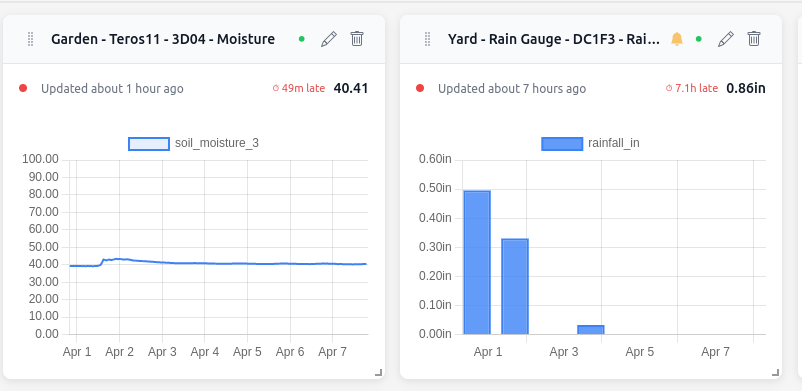
The TEROS11 measures volumetric water content using a sensing volume covering roughly one liter of soil (1010 mL to be precise) around the probes. A helpful way to visualize this is to think of it as a mason jar full of soil buried at about 4 inches deep.
Before the rain, that jar-sized-space contained roughly 1.5 cups of water. The rain event corresponds to adding about a 0.25 cups to that mason jar. The additional water was retained in the mason jar zone for roughly two days, slowly draining off and returning to the starting point.
In full transparency, the soil science side of this is still new to me. I am comfortable building the computer and electronic systems that collect and record the data, but interpreting what that data actually means is a completely new field of study for me. This case study is primarily intended to validate the that the HiTechHomestead solution can reliably collect time-series soil moisture data (the engineering part), but I’m also hoping to glean some insight and use the data collected to improve my own irrigation methods and improve plant performance and yields. In my quest to make sense of the data I’ve collected, I spent some time reading through The Researcher’s Guide to Soil Moisture published by METER Group (the company that manufactures the TEROS sensors). So far I’ve learned that this VWC behavior is commonly referred to by soil scientists as “the leaky bucket model”, and this case study has grounded some of the theory discussed there with real-world data.
I’ve learned that soil type plays a major role in how water is stored and moves through the ground. Using the USDA Web Soil Survey website, I found that my farm in the Willamette Valley is almost entirely Malabon silty clay loam. This type of soil typically holds water well and drains slowly. Based on both published ranges and what I’m seeing in the raw collected data, my soil appears to settle near field capacity around 40% VWC. Field capacity is is the amount of water that a given soil can hold before it becomes saturated, and is best measured 2-3 days after a substantial wetting event before the growing season when evaporation rates are low.
The other critical number seems to be the permanent wilting point, which is the point at which there is so little water in the soil that plants can no longer extract it and wilt irrecoverably. Different plants have different abilities to extract water from the soil and therefore have different permanent wilting points. The amount of water available to a plant is essentially the band between the plants wilting point and the field capacity of the soil in which it is planted. This is commonly referred to as the total available water.
It seems the common best practice is to aim to keep the total available water at no less than 50% for most crop types, and is the point where irrigation should begin. The specific threshold depends on the crop and is typically referred to as the management allowable depletion. I have not established that number yet for my garden, but this system should make it possible to observe and define it over time.
This first rain event is just one data point, but it has already provided a clearer picture of how water is interacting with the soil at root depth, and has got me thinking about how and when I will change my irrigation schedules this summer.
The Case for HiTechHomestead
Meter Group’s TEROS11 and TEROS12 are widely used in controlled environments where dense, wired deployments are the norm. In my research, it seems that using them across a larger properties is where things get a bit complicated and costs balloon as the number of data loggers increases.
Most available solutions assume sensors are either wired together to a single data logger or located within reliable Wi-Fi or cellular coverage. That approach works fine when everything is reasonably close together or cost is not a major concern, but once you spread out across a larger property, you are either running long cables, dealing with unreliable connections, or relying on cellular infrastructure that is outside of your control. All of these add cost and complexity.
There are well-established systems that specialize in supporting these types of large scale deployments, and I’m sure do it reasonably well. Many seem to be built around a cloud-first model, where data is collected in the field via cellular or wifi, sent to a centralized cloud service, and accessed through a web or mobile application. In all fairness, I do not have detailed information on any of these systems because I have yet to find one that doesn’t require scheduling a sales consult to get basic information about the system performance, or specifics of initial setup requirements and ongoing operational costs. This is very likely not an issue for large scale producers and they certainly benefit from the streamlined initial deployment of sensors that provides a reasonably polished user experience out of the box.
Unfortunately, that convenience is built on a set of assumptions that doesn’t scale down efficiently to the small farm operation.
In exchange for the ease of use, you are trading away some level of autonomy and essentially outsourcing the core technology that drives the system. This includes the cellular connectivity, cloud servers, subscription-based platforms, and off-site data storage. For many users, that tradeoff makes sense, but leaves your operation exposed to unexpected changes in pricing, or 3rd-party vendors going belly-up.
With HiTechHomestead we choose a different path and intentionally prioritize systems that are locally owned and operated. Data is collected, stored, and processed on infrastructure that you control. The system does not depend on a 3rd-party service to continue functioning, and it does not require ongoing subscriptions to retain access to core features. We have seen far too many folks get burned by big corporation buying up some successful/innovative smart solution, only to shut the whole thing down later when they decide it’s no longer profitable, leaving everyone who bought into the technology with an expensive paperweight.
For HiTechHomestead, convenience still matters, but cannot come at the cost of the core principle that the user is in control and a self-hosted solution is a hard requirement. The system starts with a local-first foundation and then builds toward making that easier to deploy, expand, and access. One of the design goals has been to provide a smooth on-ramp to large-scale, integrated sensing solutions that are currently only possible via cloud subscriptions.
At the most basic level, it is possible to deploy a functioning HTH setup that behaves like a reliable distributed data logger in a matter of hours and for a fraction of the cost. The firmware, toolkit, and system behavior have already been tested end-to-end and demonstrated in this case study. From a user standpoint, the work on your plate is sourcing components from our parts lists, assembling sensors according to our detailed guides, and connecting the sensor to the core HTH infrastructure that you own and operate. At HTH we want to empower users to build systems that they understand and can maintain and expand.
Our approach gives the user all the power to scale in both complexity and cost based on specific needs on your farm. Sensors can be added incrementally depending on the needs of the property. That could mean starting with a single soil moisture sensor and expanding to include rainfall tracking, temperature monitoring, irrigation flow measurement, or adding additional probes at different depths, or at different locations with different soil types.
The same core infrastructure supports all of it, and I am actively working to expand the list of supported sensors and use cases that bring the most value to small farmers and homesteaders like me.
If you are interested in this project, the ongoing results of this case study, or would like to try out the HiTechHomestead demo deployment on your own farm, please subscribe!