
Soil Moisture Case Study: Update #2
Evaluating performance of VH400 vs TEROS11
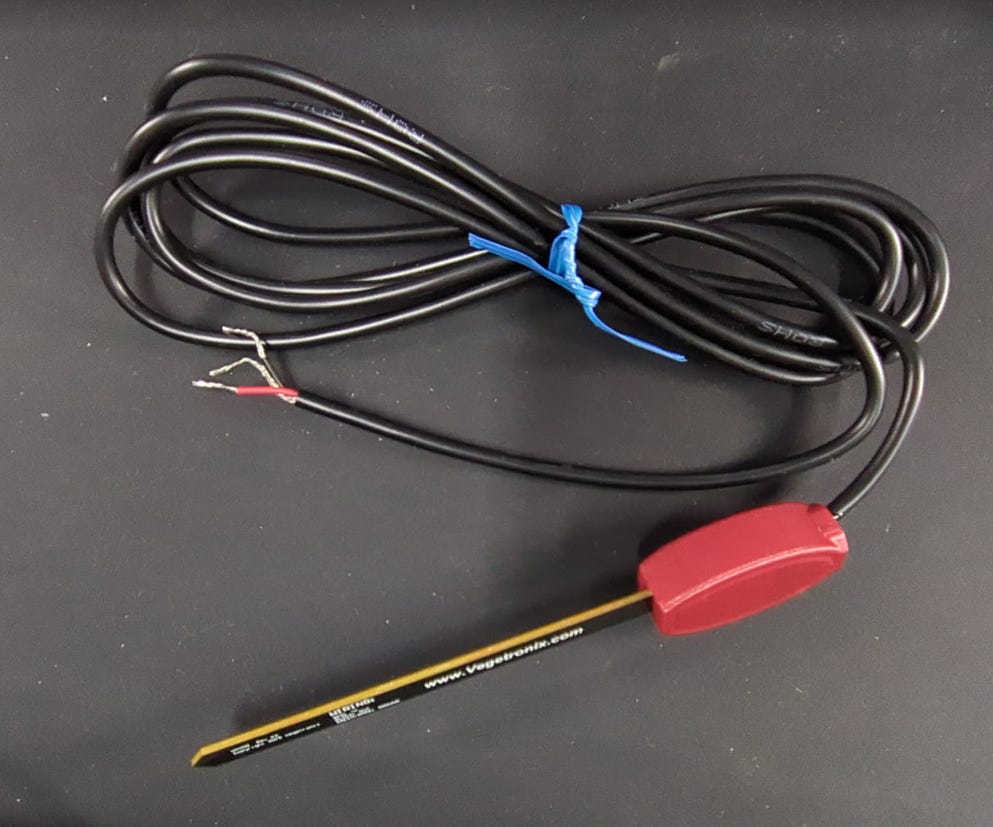
In my last case study update I was primarily focused on the first rainfall event since deploying the sensors and looking at how the overall system responded. That part behaved about the way I expected. The moisture readings from soil sensors moved up with the rain events, settled back down over time, and generally lined up with what I would expect based on the actual conditions.
In that update I completely omitted the results I had collected from the VH400. The main reason was that I was seeing values that didn’t make sense when interpreted using the calibration curves provided by Vegetronix. After applying the suggested calibration curves to the raw data, the sensor was reporting more than 70% volumetric water content most of the time. That did not seem to line up with the TEROS readings, the recent weather, or the actual condition of the soil so I wanted to investigate further before reporting my initial results.


My first assumption was that I had done something wrong in the way I connected or powered the sensor. The VH400 is an analog device and per the documentation needs a minimum of 3.5 volts input in order to generate a 0-3 volt output signal. The way I had connected everything for low-power operation, I was only giving the input about 3.2 volts on the supply. I had tested this on the bench before deploying and confirmed that the onboard ADC was reading an accurate voltage from the sensor and didn’t suspect the ADC to be the root of the problem. My initial concern was that I was under-volting the power supply of the VH400 which was causing inconsistencies in the output and this was leading to the deviation from the expected curves.
To test that hypothesis, I reworked the setup to power the sensor using a dedicated 12V supply from a RAK5811. The idea was to remove as much uncertainty as possible from the excitation side of the measurement and see if the reported values would move closer to something reasonable. Not totally unexpectedly (but also somewhat to my disappointment) VWC reported by the sensor went further up rather than down.
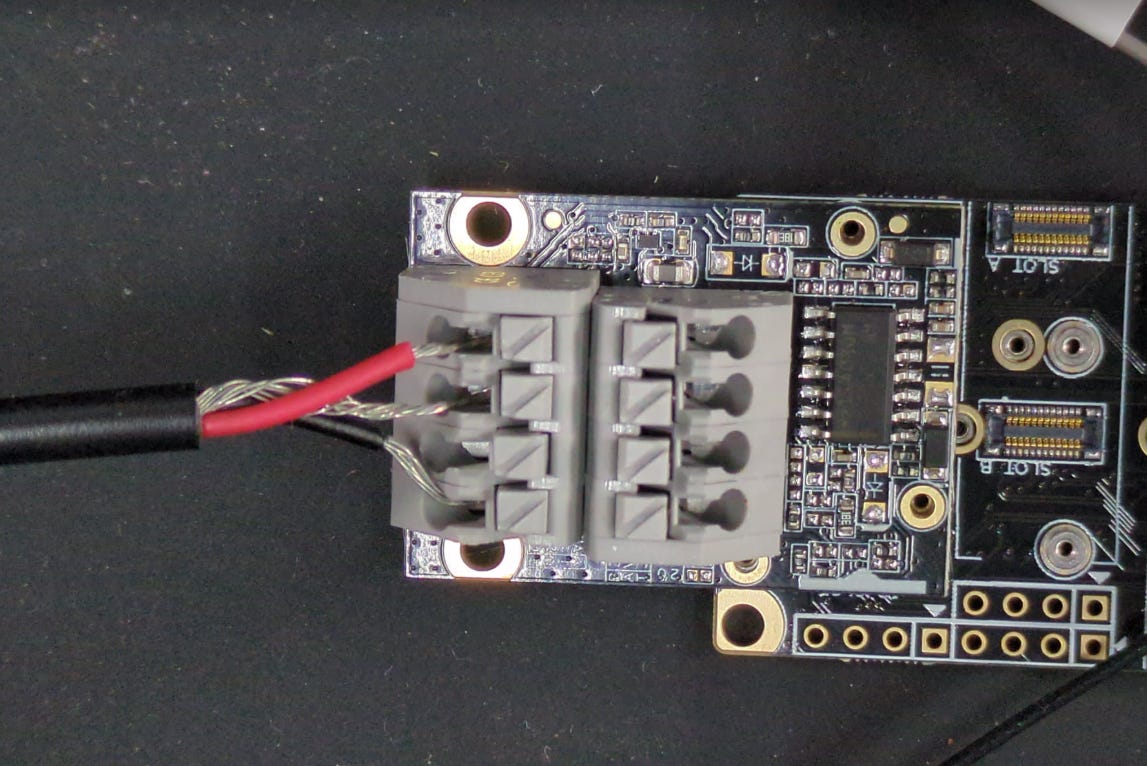
Ultimately this confirmed my initial suspicions that the default VWC curves are likely not directly applicable to the soil on my farm. The sensor is clearly producing a signal that responds to relative changes in soil moisture, but I do not currently have a way to interpret that signal as an absolute volumetric water content using the stock calibration curves.
I would expect to see the VH400 sensor readings top out at no more that 2.2V which roughly correlates to 50% VWC based on Vegetronix documentation. In my current situation, with soil near field capacity (should be ballpark 40% for silty clay loam soil) I am consistently getting readings in the range of 2.8V with a 12V supply. Running this through the suggested VWC formula for produces a computed VWC of 87.5% which doesn’t make sense to me.
VWC= 62.5*V - 87.5
VWC = (62.5 * 2.8) - 87.5
VWC = 87.5
One other thing I have noticed is that the VH400 output will fluctuate throughout the course of the day even when soil conditions are mostly stable. When compared to stable TEROS11 readings, the VH400 raw ADC values seem to fluctuate with temperature. I do not yet know if the variation is coming from the sensor itself, from the ADC on the node, or from some interaction between the two and further investigation is needed to understand what is going on.


Fortunately, even with these oddities, I still expect that the VH400 will be a valuable sensor since the signal still moves in the right direction. It responds to rain, and it trends downward as the soil dries. For most practical soil management purposes, that should be enough. If the goal is to understand whether the ground is getting wetter or drier over time, the sensor should still provide actionable data. At this point I am less confident that it can serve as a reliable source for objective VWC without further soil-specific calibration and some form of active temperature compensation. For now, I am treating the VH400 as a usable relative moisture sensor and the TEROS as the reference for this study. I will continue to compare the readings from the TEROS against the VH400, and also plan to try another TEROS11 and TEROS10 to see if I can confirm a source of truth. The other thing I will try within the next couple days is to go out and disconnect the VH400 output from the RAK 5811 board input. Using a multi-meter or pocket oscilloscope I should be able to determine if the sensor output voltage is somehow being affected by something on the RAK board itself or possibly in the the firmware.
Overall this is not as clean of an outcome as I had initially hoped, but certainly is not a deal breaker. The VH400 is positioned as an excellent value option when you need a sensor that is more durable the the $3 Amazon sensors, but don’t need the soil-study accuracy that the TEROS sensors provide. In the ballpark of $40 per sensors, the VH400 is a reasonably well ruggedized sensor that can be deployed quickly, or even buried underground directly out of the box. Even if I can’t nail down the exact cause of the VWC variations, I think we will still be able to make informed irrigation decisions based strictly on the readings from a VH400.